
The partnership premium:
Stronger Australian Council-Supplier relationships and better outcomes
In collaboration with

Executive summary
The foundations of the relationship between local councils and their suppliers are stronger than many assume. This report indicates that many of the essentials are in place and that there is potential for meaningful performance uplift. In many cases, council-supplier relationships are workable and constructive. Mobilisation is generally effective, communication during delivery is often sound, and disagreements tend to be resolved early and informally rather than through formal dispute routes.
However the central finding is one of underperformance. The system suffers from persistent friction, producing caution where it needs judgment, compliance where it needs dialogue, and administration where it needs commercial leadership. These weaknesses are structural. Councils and suppliers describe the same problem from different sides of the relationship. Councils want better outcomes, stronger supplier performance, more innovation and bettervalue for money. Supplier innovation is welcomed but not consistently enabled. While most councils (61%) report that suppliers occasionally suggest improvements during contract delivery, suppliers remain divided on whether those ideas are effectively evaluated and adopted. More suppliers describe councils' processes as mostly unclear and ineffective (42%) than mostly clear and effective (40%). Suppliers want earlier engagement, clearer scopes, more collaborative relationships and more flexible contracting. These agendas align - they are two views of the same missing capability.
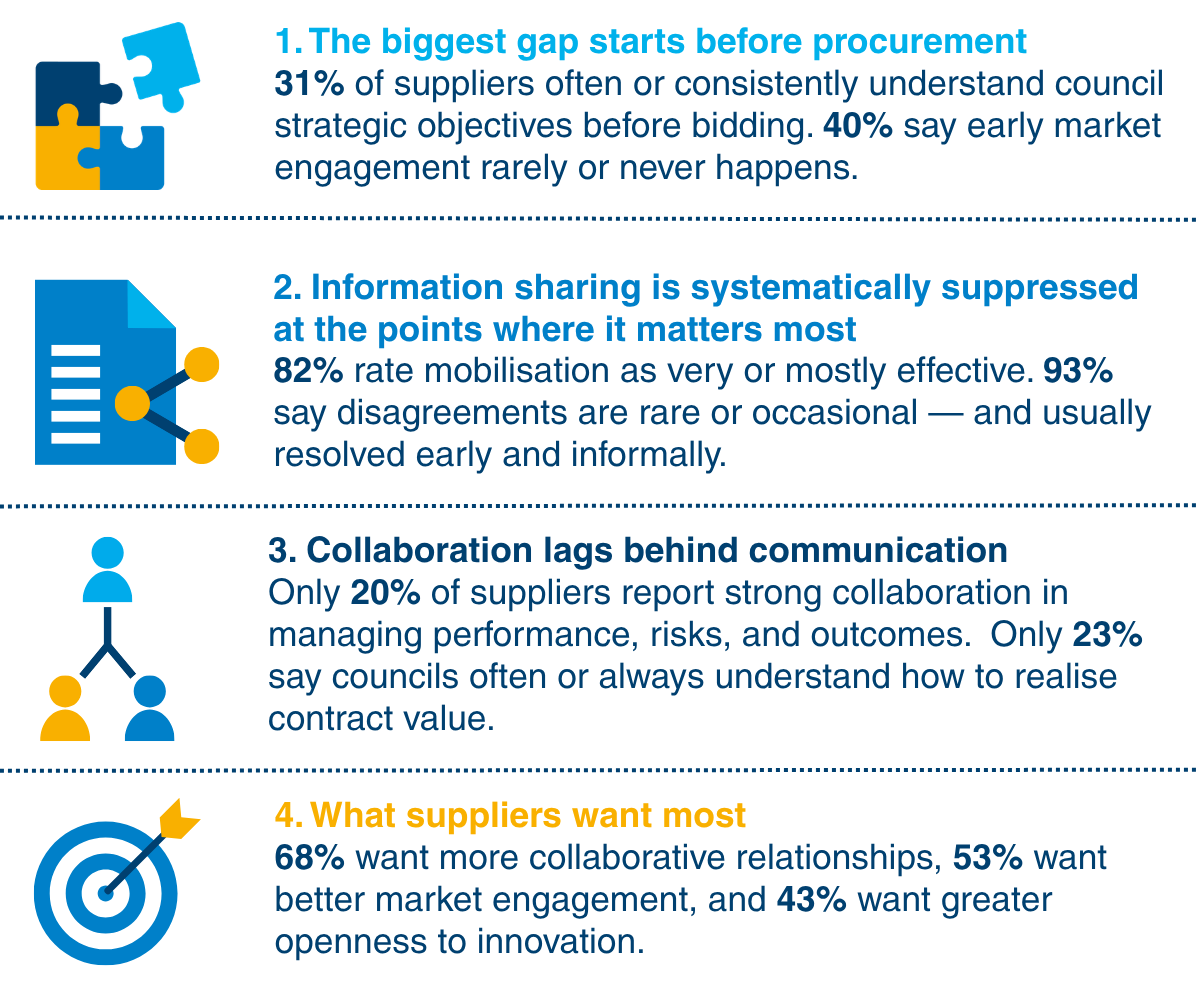
What emerges is a picture of relationships that are generally functional but rarely strategic. Much already works, but the elements that matter most to long-term value - market engagement, commercial design, authority, innovation and post-award value realisation - still need redesign. The conclusion is simple: transactional structures are limiting strategic outcomes. Better value for money demands more than tighter process or firmer control. It requires clearer intent, stronger commercial capability and relationships designed to turn contracts into results.
The partnership premium: stronger Australian Council-Supplier relationships and better outcomes

Conclusion
The research shows that Australian councils and their suppliers have a positive, cooperative, and low-conflict relationship.
Both sides want a more strategic partnership, but most relationships have not yet reached that level. Baseline delivery is strong across every council type. Disputes are resolved informally and early, with legal and external routes reserved as a genuine last resort. Problem-solving discussions are largely blame-free, suppliers raise delivery issues early, and confrontational behaviour registers at essentially zero across every measure in the survey. Where personnel continuity exists, it is valued and protective of trust. Suppliers are willing to reflect on their own role, and councils are not seen as uniformly rigid or adversarial. These are real foundations.
However the relationship weakens at the points requiring flexibility: openness to negotiation, change management, issue escalation and timely decision-making are the weakest dimensions in an otherwise steady delivery picture. Risk is described as shared in principle but almost never seen as ‘well balanced’ in practice. Early market engagement is rare almost everywhere. Negotiation may be professional but is viewed as positional, frequently blocked by policy (real, imagined, or perhaps convenient).
Councils demand and reward capability, track record and compliance at the point of award, and they are fairly disciplined in doing so. Yet they rarely do the upfront work that would let suppliers demonstrate those qualities earlier, surface risks sooner, or shape more realistic or more creative requirements before a tender is issued. The bottleneck sits upstream, with councils themselves and it is not the same across tiers. Metropolitan councils need the confidence and capacity to run early engagement well. Regional and rural councils need policy room and maturity to make it worth doing at all. Closing that upstream gap, rather than tightening criteria at an award stage that is already disciplined, is the more promising lever for better outcomes.
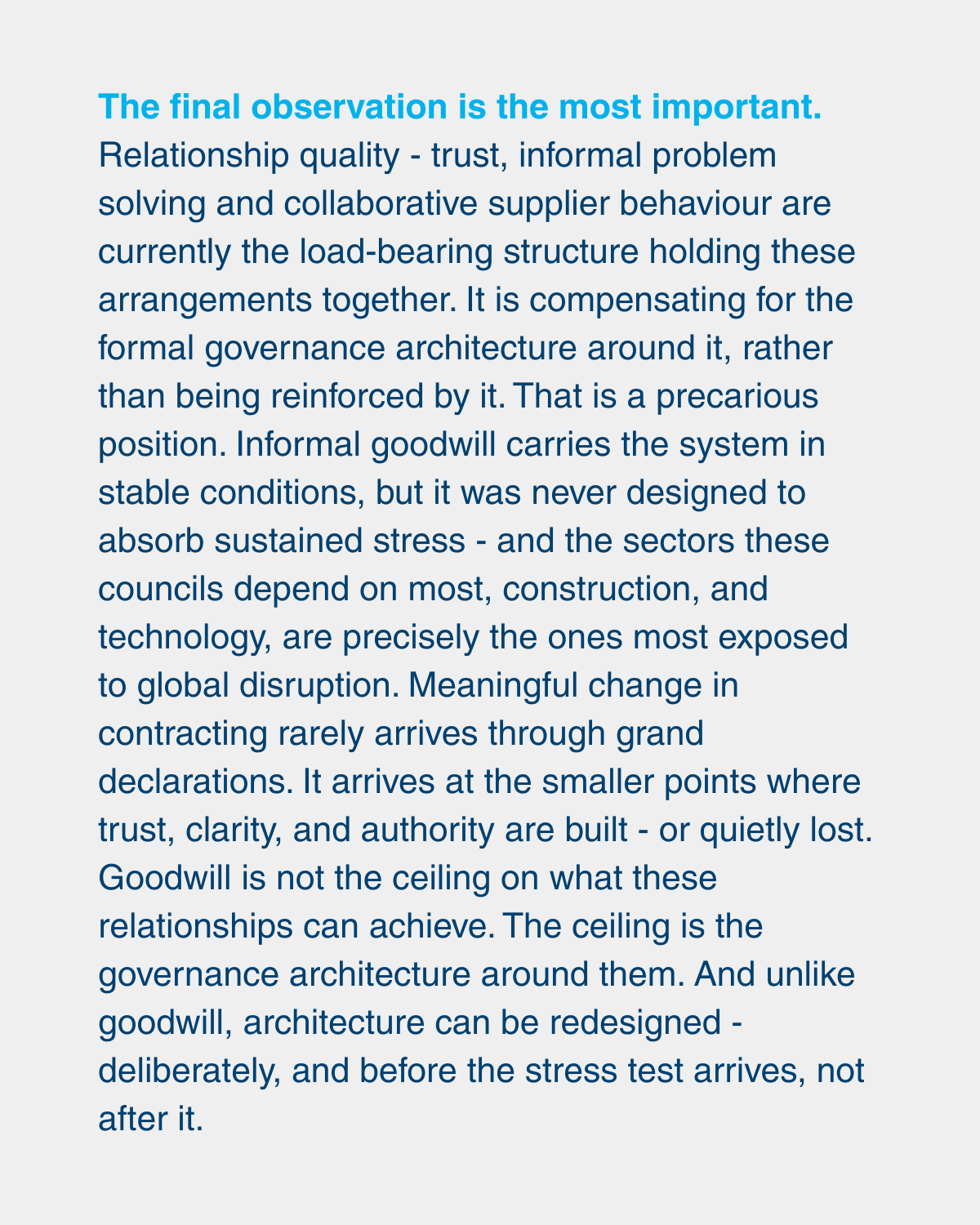
This survey suggests councils now have an opportunity to simplify, clarify and modernise without losing the safeguards that matter. The story it tells is one of missed value before contract award, followed by practical recovery once delivery begins - a system that gets contracts delivered but underuses supplier insight, limits innovation and leaves value on the table. The remedy is better commercial design, earlier dialogue and clearer relationship intent, not more process.
The partnership premium: stronger Australian Council-Supplier relationships and better outcomes
Written by

An international, cross-industry career that has moved from corporate management to extensive research, advisory and capability development services to public, private and third sector organisations. Tim has lived and worked in the UK, France (3 years), and the United States (20 years), building an impressive research and entrepreneurial record with a demonstrated commitment to delivering social benefit. As Founder and President of World Commerce & Contracting (formerly International Association for Contract & Commercial Management), Tim has built a 72,000-member worldwide non-profit association which increasingly influences commercial policies and contracting practices in major corporations and governments. In September 2019, he was presented with the Financial Times ‘Market Shaper of the Year Award. Tim was, until recently, Professor and Chair of International Commercial & Contract Management at the University of Leeds, School of Law, where he taught and led the development of inter-disciplinary commercial programs. Prior to founding World Commerce & Contracting, Tim was on the Chairman’s staff at IBM Corporation and led the development of worldwide commercial processes and skills. His early career included management roles in the banking, automotive and aerospace industries, where he led negotiations up to $1.5 billion in value. He has served in advisory roles for government departments in various countries, including the US, UK, Australia, Canada, and Japan.
Resources
From webinars to articles and events we have a whole host of resources to help you on your journey to AI excellence.

Benchmark 2025
Curious to understand how commercial and contract management teams are responding to uncertainty? Download the 2025 Benchmark Report for key insights into accountability, process maturity, technology adoption, and the capabilities organizations need to build resilience and improve performance.

Articles
Our Knowledge Library boasts an extensive collection of AI articles, delving into the transformative impact on contracting and commerce. As leaders in the field, we offer valuable insights and thought-provoking content, illuminating AI's revolutionary potential in the contracting landscape.
Tips & Checklists
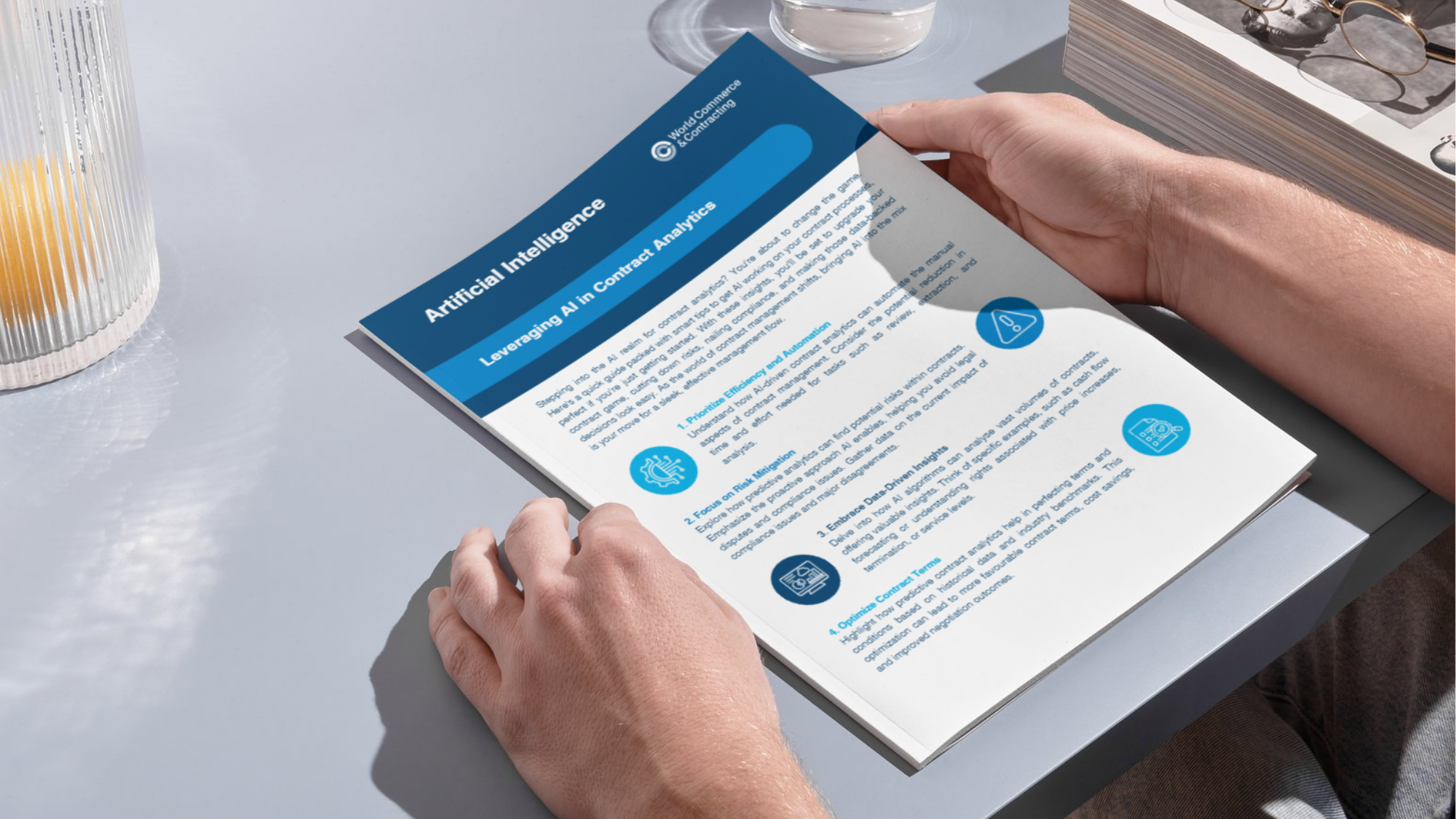
As commercial complexity grows, our Tips & Checklists go beyond theory to give you actionable, bite-sized guidance. Access practical frameworks, quick-reference guides, operational advice, and immediate takeaways to simplify contract management and mitigate risk across your commercial lifecycle.
Become a member
Join now to access a range of benefits as part of the world's largest commerce and contracting community.
- Become part of a global community and connect with other members at events and on online forums.
- Participate in live webinars and sponsored webcasts with thought leaders and experts.
- Attend local networking groups and regional or international conferences.
- Access the latest research, reports, analytics, best practice templates and thought-leadership articles.
- Become certified with our globally recognized training programs.
- Gain one-on-one mentorship from our experts.
- Receive regular news and industry updates.
- Search and post jobs on our members job board.
- Raise your professional reputation by contributing to our Content Hub, joining working groups, speaking at conferences, and contributing to research.