
SMEs in the AI-enabled Contracting Landscape
New realities, new capabilities, and the opportunities ahead

In partnership with
Developed by
![[White] Spotdraft Logo for web](https://info.worldcc.com/hs-fs/hubfs/%5BWhite%5D%20Spotdraft%20Logo%20for%20web.png?width=205&height=40&name=%5BWhite%5D%20Spotdraft%20Logo%20for%20web.png "[White] Spotdraft Logo for web")

Executive summary
Small and Medium Enterprises (SMEs)operate in a contracting environment that is every bit as complex and uncertain as that faced by larger corporations - and given their more limited resources and market power, in many respects, more so.
We are entering a moment of major change for businesses of all sizes. For SMEs in particular, artificial intelligence is no longer a future concept, it is already reshaping how companies find opportunities, negotiate, deliver work, and create value. The shift is practical, fast, and directly linked to competitiveness.
While big companies are still debating overnance and regulations, many SMEs are already taking the lead in using AI for commercial and contract management. They don’t have the heavy legacy systems, long approval chains, or risk-averse cultures that slow larger organizations down. Instead, they are adopting what we can call “entrepreneurial AI”, practical, flexible and impactful uses of AI that are already reshaping their competitive edge.
For decades, SMEs have faced an inherent disadvantage, limited resources to invest in sophisticated contract management systems, specialized legal expertise, or dedicated commercial teams. AI is changing this equation entirely. Today, a small manufacturing company can leverage AI-powered contract analysis tools that rival the capabilities of major law firms. A medium-sized service provider can implement intelligent risk assessment systems that would have cost millions just five years ago.
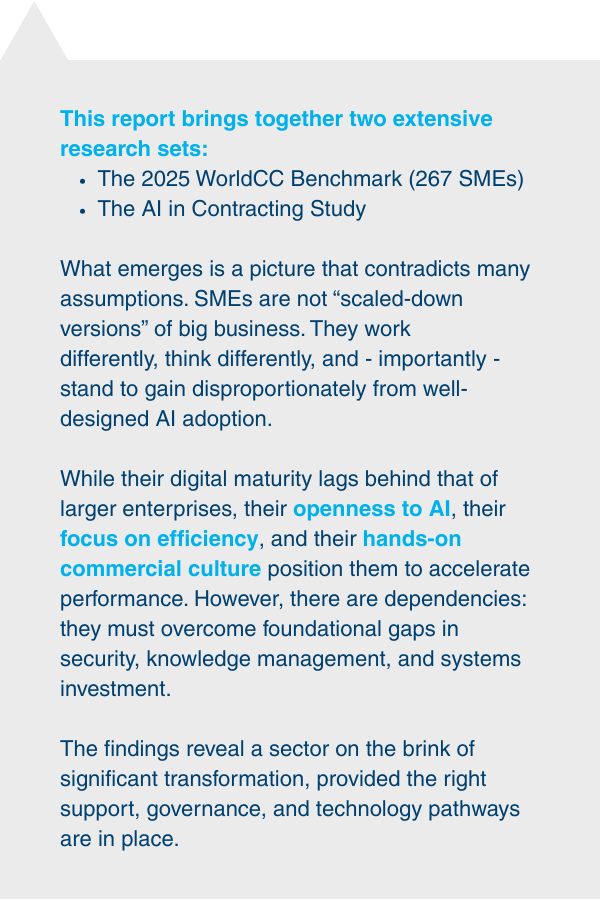
This isn’t just about efficiency; it’s about survival and analyzing how competitive companies can become. Although the question is not whether SMEs can afford to adopt AI, it is whether they can afford not to. Yet WorldCC’s 2025 research shows that SMEs are navigating these pressures with surprising sophistication. They are engaging in high-complexity contracting, negotiating intensively, managing uncertainty at levels and in ways that compare favourably against larger organizations, and adopting AI with a pragmatism that reflects their resource constraints and commercial priorities.
SMEs in the AI-enabled Contracting Landscape
New realities, new capabilities, and the opportunities ahead


Key takeaways
1. SMEs engage in high-stakes, high-complexity contracting
37% of SME sales revenue and 31% of buy-side spend involve high-complexity contracts, debunking the myth that SMEs only handle low-risk, transactional agreements.
The Solution: SMEs must adopt AI-powered analysis and risk assessment tools to gain "big-company" capabilities without needing the massive infrastructure usually required for sophisticated governance.
2. Uncertainty is a universal "great equalizer"
The perception of uncertainty is nearly identical between SMEs (4.2) and large enterprises (4.24), yet SMEs have fewer financial and workforce buffers to manage it.
The Solution: Shift from informal, behavioral adaptability to AI-enabled "entrepreneurial AI" that provides scalable control and foresight.
3. A significant "enthusiasm vs. execution" gap exists due to security
68% of SMEs view AI as a partner, but 72% of non-users cite security and privacy as the primary barrier to adoption.
The Solution: Invest in secure, internal AI tools with robust access controls and data encryption to transition away from risky public LLMs.
4. SMEs negotiate the majority of their contracts but have specific risk priorities
75% of SME contracts are negotiated, with a heavy focus on indemnities, payment terms, and operational clarity to protect cash flow.
The Solution: Utilize AI-enabled playbooks and scenario modeling to equip staff with the same level of sophistication as larger firms, thereby reducing cycle times and overcommitment.
5. Digital infrastructure and knowledge management are foundational gaps
Only 6% of SMEs report "mature" knowledge management, while 65% admit it is rudimentary or under development.
The Solution: "Get the foundation right" by standardizing templates, clause libraries, and improving data capture discipline before attempting advanced AI scaling.
6. SMEs are focusing on "low-hanging fruit" for immediate ROI
Current adoption is highest in workload-reducing tasks: contract summarization (56%), drafting (56%), and review (53%).
The Solution: Follow a practical roadmap by starting with low-risk, high-value AI applications (summarization and drafting) before moving into predictive analytics .
Conclusion: SMEs as catalysts of AI-driven commercial transformation
SMEs bring agility, pragmatism, and a willingness to embrace technology, and they also face constraints - limited budgets, fragmented systems, and heightened exposure to commercial risk.
But their openness to AI, especially for those with deep involvement in high complexity contracting, positions them as potential leaders of the next wave of commercial innovation.
If they can strengthen foundational processes, overcome security and knowledge management barriers, and invest in targeted AI capabilities, SMEs will not merely “keep up” with larger enterprises. They will outperform them in adaptability, customer responsiveness, and commercial insight.
The message from the data is clear: AI-enabled SMEs can become the most dynamic actors in tomorrow’s contracting landscape.
“The biggest shift is cultural: contracts are no longer ‘a legal problem’, they are becoming the company’s execution layer.”
(General Counsel, Healthcare SME)
SMEs in the AI-enabled Contracting Landscape
New realities, new capabilities, and the opportunities ahead
Written by
Tim Cummins

An international, cross-industry career that has moved from corporate management to extensive research, advisory and capability development services to public, private and third sector organisations. Tim has lived and worked in the UK, France (3 years), and the United States (20 years), building an impressive research and entrepreneurial record with a demonstrated commitment to delivering social benefit. As Founder and President of World Commerce & Contracting (formerly International Association for Contract & Commercial Management), Tim has built a 72,000-member worldwide non-profit association which increasingly influences commercial policies and contracting practices in major corporations and governments. In September 2019, he was presented with the Financial Times ‘Market Shaper of the Year Award. Tim was, until recently, Professor and Chair of International Commercial & Contract Management at the University of Leeds, School of Law, where he taught and led the development of inter-disciplinary commercial programs. Prior to founding World Commerce & Contracting, Tim was on the Chairman’s staff at IBM Corporation and led the development of worldwide commercial processes and skills. His early career included management roles in the banking, automotive and aerospace industries, where he led negotiations up to $1.5 billion in value. He has served in advisory roles for government departments in various countries, including the US, UK, Australia, Canada, and Japan.

Resources
We have a whole host of resources to help you on your journey to commercial and contracting excellence.
Contract Management Standard (CMS)™
The Benchmark Report 2025 highlights a lack of consistency and accountability in contracting. The CMS is the globally recognized, definitive framework that provides a common language and a structured view of the contract lifecycle (pre-award, award, and post-award) required to drive consistency and achieve better outcomes.

Latest Research
Curious about the shifting landscape of contracting? Dive into our latest research. Get cutting-edge insights on current trends, innovations, and the practical implications for commercial and contract management, examining both today's applications and tomorrow's possibilities.

Capability Maturity Analysis (CMA) and Benchmark
The Benchmark 2025 report is an aggregate analysis. The individual CMA is the practical tool for organizations to take the next step: gaining a fact-based view of their own current performance against industry norms and world-class standards. The report identifies a growing performance gap; the CMA helps an organization see exactly where it stands.

Articles
Our Content Hub boasts an extensive collection of AI articles, delving into the transformative impact on contracting and commerce. As leaders in the field, we offer valuable insights and thought-provoking content, illuminating AI's revolutionary potential in the contracting landscape.

CCM Associate Program & Certification
The report notes misalignment in priorities, where organizations want strategic relevance but de-prioritize talent development. The CCM Associate program addresses the need to develop a foundational skillset aligned with the CMS, making it an ideal first step for upskilling teams to manage the complexity and uncertainty highlighted in report.

Events
Join us for a variety of in-person and online events, from dynamic weekly thought leadership webinars and digital takeovers to our regional member meetings. Don't miss the chance to connect with the global community at one of our essential global annual summits.
Become a member
Join now to access a range of benefits as part of the world's largest commerce and contracting community.
- Become part of a global community and connect with other members at events and on online forums.
- Participate in live webinars and sponsored webcasts with thought leaders and experts.
- Attend local networking groups and regional or international conferences.
- Access the latest research, reports, analytics, best practice templates and thought-leadership articles.
- Become certified with our globally recognized training programs.
- Gain one-on-one mentorship from our experts.
- Receive regular news and industry updates.
- Search and post jobs on our members job board.
- Raise your professional reputation by contributing to our Content Hub, joining working groups, speaking at conferences, and contributing to research.